
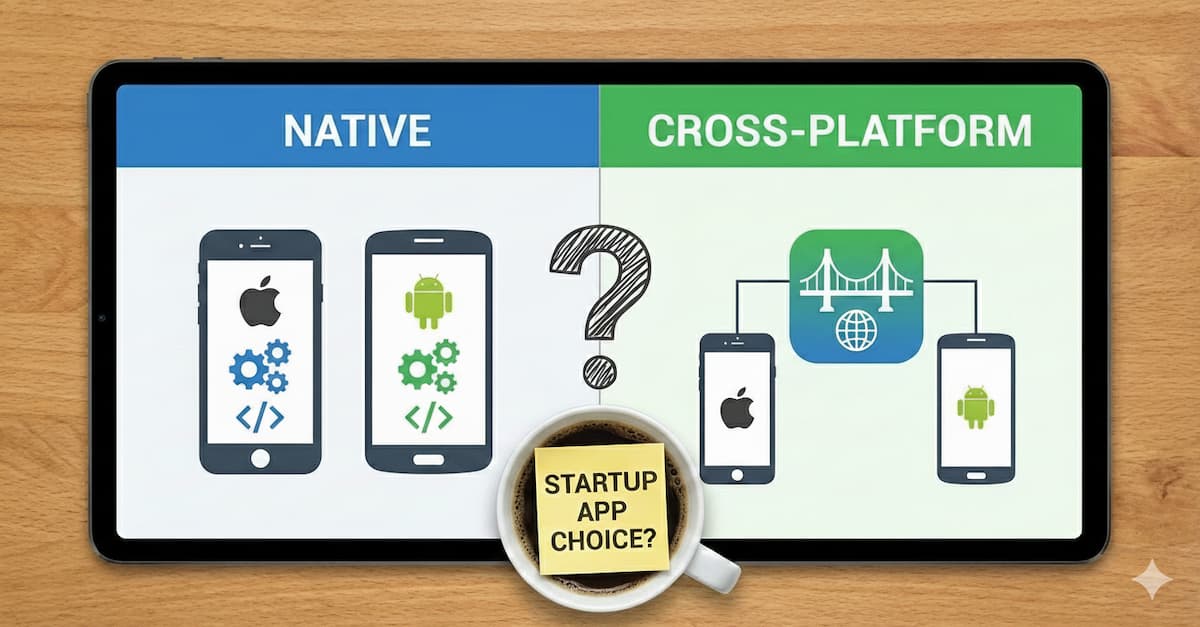
One of the first and most critical decisions you'll make when building your startup app is choosing between native and cross-platform development. This choice affects everything from your initial budget and timeline to your app's long-term performance and maintenance costs. Many entrepreneurs struggle with this decision because they don't fully understand the trade-offs or worry about investing too much too soon.
Over many years helping startups in Montreal and beyond, I've seen how this single choice can make or break a project. I remember one client who had a promising app idea but was hesitant because he wasn't sure whether his concept was feasible given his limited budget. By walking him through the trade-offs and planning a cross-platform MVP, he was able to launch quickly, validate his idea, and make smart decisions without overspending. That's the kind of guidance I bring to every startup I work with.
In this guide, I'll break down the real-world differences between cross-platform and native development so you can make an informed choice that fits your startup's goals, budget, and timeline.
Understanding Your Options
Native Development
Native development means building separate apps for Android (Kotlin/Java) and iOS (Swift/Objective-C). Each platform has its own codebase, optimized for performance and platform-specific features.
Pros
- Maximum performance and access to all platform features
- Ideal for apps with complex animations, real-time data, or heavy computations
Cons
- Higher development and maintenance costs
- Slower multi-platform launches
Cross-Platform Development
Cross-platform frameworks allow you to write one codebase that runs on both Android and iOS.
Pros
- Lower development cost and faster time-to-market
- Easier iterations and updates
- Great for MVPs and startups with limited resources
Cons
- Slight trade-offs in performance for complex apps
- Dependent on the framework for updates and some platform features
Comparing the Options
| Factor | Native | Cross-Platform |
|---|---|---|
| Cost | Higher, separate codebases and teams | Lower, one codebase, one developer or team |
| Speed | Slower for multi-platform | Faster launches on both platforms, quick iteration |
| Performance | Best, direct platform code, ideal for heavy computation and animations | Very close to native, app size slightly larger in some cases |
| Maintenance | Higher, two codebases, full control | Lower, one codebase, easier to maintain |
When to Choose Native
Native development makes sense if:
- You are launching on one platform first, iOS for most B2C apps, Android for emerging markets
- Performance is critical, such as gaming, real-time apps, or complex animations
- You have a larger budget and a dedicated long-term development team
When to Choose Cross-Platform
For most startups, cross-platform development is the better choice if you want to save time and costs while reaching both iOS and Android users. It is ideal when:
- You need to launch on both platforms quickly
- You have a limited budget but want Android and iOS coverage
- You are building an MVP to validate your idea fast
- You want good performance and a polished user experience without the complexity of maintaining two separate codebases
Cross-platform frameworks allow you to achieve these goals efficiently, helping you get to market faster and make informed decisions based on real user feedback.
The Startup Reality
For most startups, my approach is:
Start lean, validate fast, and minimize risk
I often advise clients to launch an MVP on both platforms using cross-platform development if they want faster results and lower costs. This approach:
- Reduces initial development costs
- Lets you test your idea with real users quickly
- Gives you flexibility to refine features before scaling
In the example I mentioned earlier, my client was able to launch a cross-platform MVP that fit his budget and still delivered a polished user experience. Once he validated the idea and saw user engagement, he confidently invested in scaling the app without wasting money upfront.
Many successful apps started this way. Instagram launched on iOS first and Uber also tested iOS before scaling to Android. You can always expand later once you have data to guide your decisions.
Making Your Decision
There is no one-size-fits-all answer. The best choice depends on your budget, timeline, target users, and app requirements. The key is understanding trade-offs and making an informed decision rather than defaulting to what seems cheapest or trendy.
If you are unsure which approach is right for your startup, I offer a free 30-minute consultation to discuss your situation, answer questions, and help you plan a cost-effective, smart app strategy. No sales pitch, just practical guidance to avoid expensive mistakes.
Ready to Build Your Startup App?
Have questions about choosing the right technology for your app? Let's discuss your project and find the best approach for your startup's needs.
Get Your Free Consultation